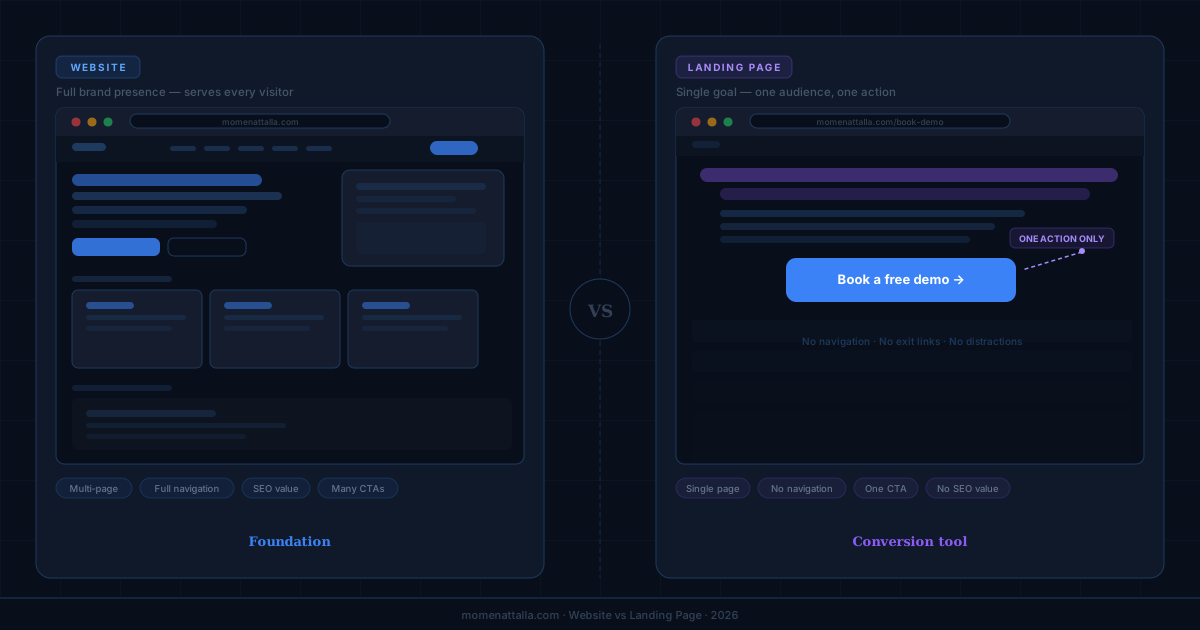
It's one of the most common questions I get — and one of the most commonly misunderstood distinctions in digital marketing.
A website and a landing page are not the same thing. They serve different purposes, work in different contexts, and getting them confused costs businesses real money every day.
This is the clearest explanation I can give you — with a straight answer at the end about which one your business actually needs right now.
What is a website?
A website is your full digital presence. It's the permanent home of your brand online — the place that answers every question a potential client might have, at every stage of their decision process.
A typical website includes:
- A homepage that communicates who you are and what you do
- Individual service or product pages
- An about page that builds trust and tells your story
- A portfolio or case studies section showing your work
- A contact page or booking flow
- Possibly a blog or resources section
A website is designed to serve multiple audiences, multiple intents, and multiple stages of the buying journey — all in one place. Someone who's never heard of you and someone who's ready to buy today should both be able to land on your website and find what they need.
What is a landing page?
A landing page is a single, focused page built for one specific goal.
It has one audience. One offer. One call to action. Everything else is stripped away — no navigation menu, no links to other pages, no distractions. The entire page exists to get the visitor to do one thing: sign up, book, buy, or enquire.
Landing pages are almost always used in conjunction with paid advertising or email campaigns. You run a Meta ad targeting restaurant owners in Budapest. The ad clicks through to a landing page specifically about your booking system for restaurants. The page has one CTA: “Book a free demo.” That's it.
The power of a landing page is its focus. By removing every exit point and every competing message, you dramatically increase the chance that the visitor does the one thing you want them to do.
The core difference in one sentence
A website builds your brand and serves your whole audience.
A landing page converts a specific audience for a specific offer.
When you need a website
You need a website when:
- You’re establishing a business presence for the first time and need somewhere permanent for people to find you
- Your clients research before buying — they want to understand who you are, see your work, and read about your process before making contact
- You have multiple services and need each one explained properly
- You’re investing in SEO — landing pages don’t rank; websites do
- You want to appear in Google searches for your industry, location, or services
- You need a professional home to point every channel to — your Instagram bio, your Google Business Profile, your email signature
A website is the foundation. Almost every business needs one.
When you need a landing page
You need a landing page when:
- You’re running paid ads and sending traffic somewhere specific — sending ad traffic to your homepage is one of the most common and expensive mistakes in digital marketing
- You’re launching a single product, offer, or promotion and want maximum conversion focus
- You’re running an email campaign promoting one thing and need a destination that matches the message exactly
- You’re testing a new offer before building it into your full site
- You need to measure conversion rate precisely — landing pages make tracking clean because there’s only one possible action
The expensive mistake most businesses make
Running ads to a homepage.
It happens constantly. A business spends €1,500 on Meta ads, sends all the traffic to their homepage, gets a 0.8% conversion rate, and concludes that “Meta ads don't work.”
The ads weren't the problem. The destination was.
A homepage is designed to serve everyone. An ad targets someone very specific with a very specific message. When that person clicks through and lands on a generic homepage, the message breaks. They don't see the thing the ad promised. They browse for a few seconds and leave.
A landing page built to match the ad's message, audience, and offer typically converts at 3–5× the rate of a homepage. Same ad spend. Completely different result.
“The single highest-leverage thing most businesses can do with their existing ad budget is stop sending traffic to their homepage and build a landing page that matches the ad.”
— Mo'men Attalla
Can a landing page replace a website?
No. And this is important.
A landing page has no SEO value. It doesn't rank on Google. It doesn't build brand authority over time. It doesn't serve the client who found you through a referral and wants to understand your full range of services. It doesn't give journalists, partners, or collaborators a place to learn about you.
A landing page is a conversion tool. A website is infrastructure.
You need both. They work together, not instead of each other.
So which one does your business need right now?
Here's the honest answer:
If you don't have a website yet — start there. A landing page without a website is a house with no foundation. Build the permanent home first.
If you have a website but you're running ads — you almost certainly need landing pages. One per campaign, per offer, per audience segment. Your homepage is not a landing page.
If you have both a website and landing pages but your conversion rate is low — the problem is usually the message, the offer, or the match between your ad and your page. That's a strategy problem, not a tools problem.
The quick decision guide
Use this to decide:
Starting from scratch with no web presence
→ Website first, always.
Running paid ads to your homepage
→ Build a dedicated landing page immediately.
Launching a new offer or promotion
→ Landing page, not a new website page.
Trying to rank on Google
→ Website with dedicated service pages — landing pages won’t help here.
Have both, still not converting
→ The problem is strategy and messaging, not the format.
Bottom line
A website and a landing page are tools. Like any tools, they work brilliantly when used for the right job — and expensively when used for the wrong one.
Most established businesses need both. The website builds the brand and earns long-term organic traffic. The landing pages convert the paid traffic into leads and sales.
If you're only going to do one thing after reading this: stop sending your ad traffic to your homepage.
Quick reference
| Website | Landing Page | |
|---|---|---|
| Purpose | Full brand presence | Single conversion goal |
| Navigation | Full menu | None |
| Audience | Everyone | One specific segment |
| SEO value | High | None |
| Best for | Brand building, organic search | Paid ads, campaigns |
| Pages | Many | One |
| CTA | Multiple | One |